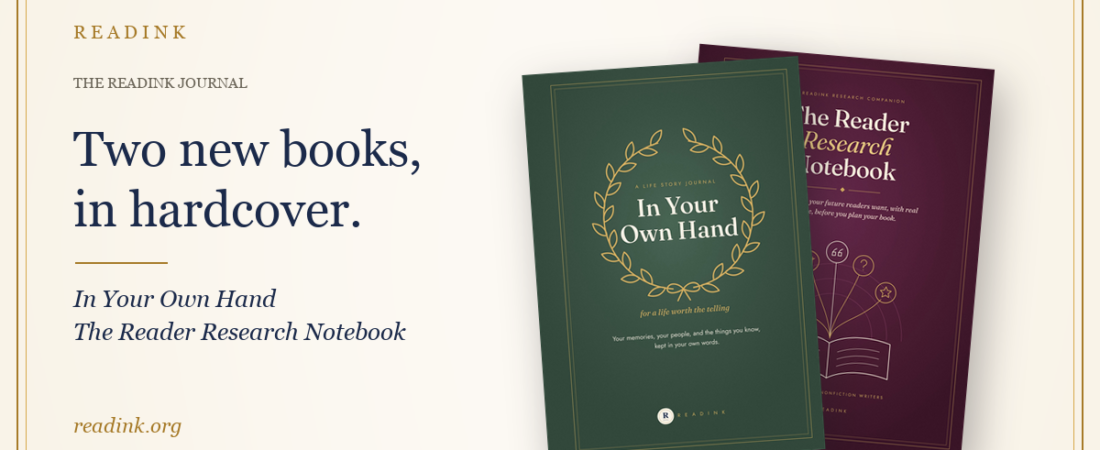
The short answer: ReadInk has two new hardcover books. In Your Own Hand is a life story journal: nine chapters of gentle questions for someone whose life is worth the telling, written in their own handwriting. The Reader Research Notebook is for writers who want to know what their future readers want before they plan a book. Both are open for pre-order now and ship in December 2026.
We made these two books for two different tables. One belongs beside a parent, a grandparent, an old friend, or anyone you wish you had asked more questions. The other belongs on the desk of a writer at the very start, before the outline, when the only certain thing is the wish to write something people will read. Both are hardcovers made to be written in and kept.
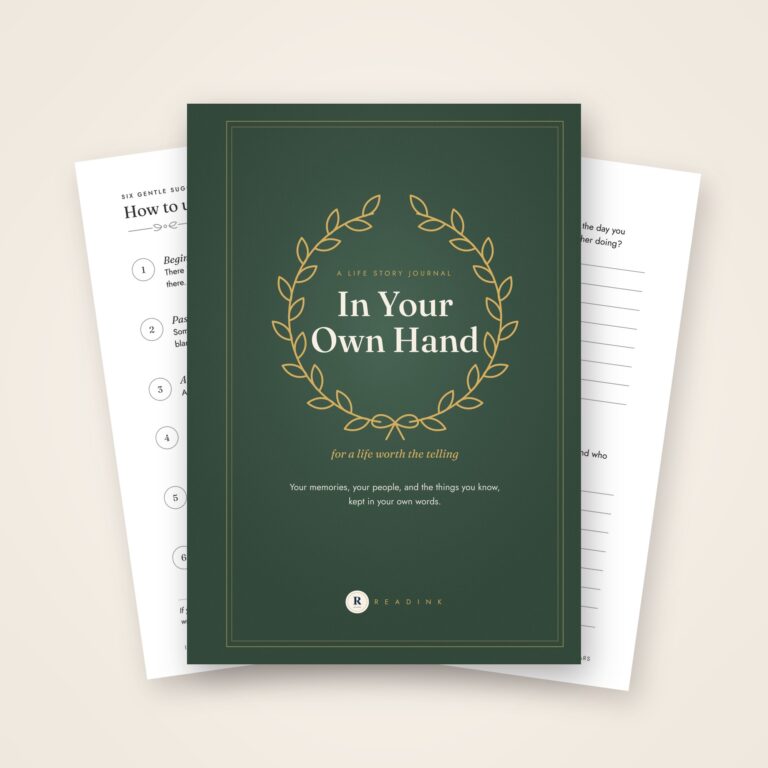
In Your Own Hand: a life story journal for a life worth the telling
Some stories live in one person: where they grew up, who they loved, what the work was like, what they believe and why. When that person is gone, the stories usually go with them. A life story journal is the simplest way we know to keep them, and handwriting is the part no recording can replace.
The journal opens with a letter to the writer, six gentle suggestions for using it, and a page that asks nothing harder than a name, a date, and three words that describe you. A family tree, a life sketched ten years at a time, and favorite things then and now follow. Then come nine chapters, each one a door the writer may open or leave closed:
- Early Years, Family, and Growing Up
- Love and Friendship, Work, and Places
- Faith and Values, Lessons, and Hopes for the Family
Each chapter has ten questions (the Family chapter has four more), one longer story to tell in full, a page of quick answers that need no hard thinking, a frame for a photograph, and one page that asks for something different: a map of a first home, a report card graded honestly, a long supper table for everyone you have ever loved.
What makes this life story journal different
Three things set it apart from the guided journals most people have seen.
- Every family fits. The family tree carries no fixed labels. Write each name, say who that person is to you, and draw the lines wherever they belong.
- Nothing is compulsory. The journal says plainly that some memories are private and some are painful, and that any question may be passed over or rewritten.
- It ends properly. Two letters, one to the person who gave the book and one to someone not yet born or too young to read it, then the questions nobody asked, extra room to write, an envelope page for small treasures, a page for what happens next, and a last page to sign.
Our advice to the giver is the same line printed inside the book: the surest way to see it filled is to sit down beside the writer, bring the pen, read a question aloud, and listen.
Who In Your Own Hand is for
It is for a mother, a father, a grandparent, an aunt, a mentor, or a friend of fifty years. It is just as much for the person who would like to set down their own story before anyone thinks to ask. It is a hardcover made to be kept on a shelf for a long time, so the paper is cream.
Pre-order In Your Own Hand in hardcover for $24.99. It ships in December 2026.
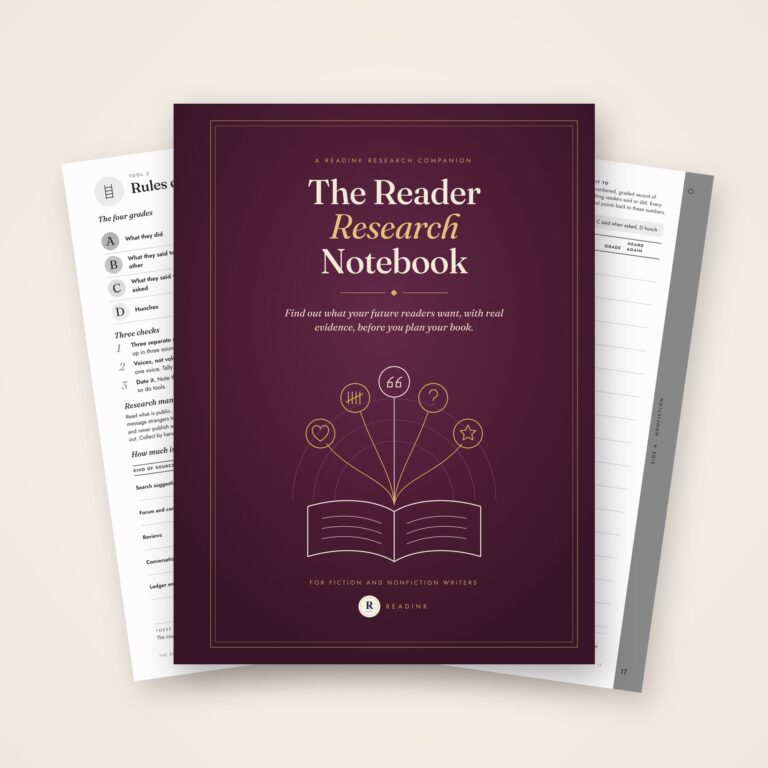
The Reader Research Notebook: know what readers want before you plan
Readers leave clues everywhere: in reviews, forums, library hold queues, and the questions they ask out loud. Many first-time writers plan from a guess about those readers and find out afterwards whether the guess was right. The Reader Research Notebook helps you test that guess against evidence first.
It is a working notebook, not a course. It holds no lessons. It gives you places to look, searches to run, and pages to record exactly what readers say, so that what you believe about your readers rests on what they said and did.
How the notebook works, in five moves
- Aim. Write a short brief and put your own guesses on record.
- Gather. Go where readers talk when no author is listening, using source maps, search recipes, and short listening conversations.
- Record. Copy readers’ exact words into a numbered ledger and grade each entry, so one loud opinion never outweighs what many readers did.
- Weigh. Count voices, check how many separate places agree, and mark your confidence honestly.
- Sum up. Fill one page, What my readers want, and carry it into whatever planning method you use.
There is a nonfiction side, with the four pulls, a shortfall sheet, and a page for the words readers really use. There is a fiction side, with reaction ledgers, an appeal profile, an expectation sorter, and the quit line, which plots where readers of a genre give up and where they get hooked. Each side has a worked example, and the hardcover has room for 192 entries in each ledger, 28 conversations, and three separate projects.
Where the methods come from
The notebook credits where its methods were borrowed from, on a page at the back. The listening rules follow customer interview practice, set out most plainly in Rob Fitzpatrick’s The Mom Test: ask about the past, and trust what people did over what they say they might do. The new-idea counter draws on the idea of saturation from qualitative research; a 2006 study by Guest, Bunce, and Johnson in the journal Field Methods, found that saturation occurred within the first twelve interviews with similar people. The fiction tools borrow from readers’ advisory in public libraries, including the appeal vocabulary used in NoveList.
What the notebook does not do is just as important. It does not outline, plan, or write your book, and it cannot promise that a book will sell. It tells you what readers want. What you make of that is yours.
For working authors and small presses
If you already have books out, the notebook is most useful before the next one. A short round of research on your own backlist readers, done with the same ledgers, can show which promises your books keep and which ones readers still wait for. The second and third project sets at the back of the hardcover can hold that research. For a small press weighing a new list, the expectation sorter and unmet requests pages can give the editorial meeting something firmer than taste.
In Your Own Hand has a place in the business too. For authors of memoir, family history, or local history, it offers another way to gather stories: some people give fuller answers on paper, in their own time, than in a recorded conversation.
How to get both books
Both hardcovers are open for pre-order on readink.org at $24.99 each and ship in December 2026. In Your Own Hand has also been submitted to Amazon and is not live there yet. If the notebook leaves you ready to begin, our guided course Write Your First Book in 28 Days is built to take you from the plan to a full draft, one sitting a day. And if you would rather start with something free, The First-Time Author’s Roadmap walks through every stage from idea to readers.
To hear when each new ReadInk book is out, join the ReadInk Letter on the home page.
Questions authors ask
When do the hardcovers ship?
Both books ship in December 2026. Orders placed on readink.org now are pre-orders, and the ship date is shown on the product page, in the cart, and on your order.
Who should get a life story journal?
Anyone whose life is worth the telling: a parent, a grandparent, a mentor, a lifelong friend, or yourself. The questions work for any family shape, and any question can be skipped.
Does The Reader Research Notebook help me write my book?
Not directly. It helps you find out what readers want before you plan, then hands you one summary page to carry into whatever planning method you use.
Is the notebook for fiction or nonfiction writers?
Both. It has a nonfiction side and a fiction side, and memoir writers can use both: one for the subject and one for how the telling should feel.
Can I buy these books on Amazon?
In Your Own Hand has been submitted to Amazon in hardcover and is not live yet. The Reader Research Notebook is not on Amazon. For now, pre-order either book on readink.org.
A good book often begins with a good question. One of these books asks the questions of the people we love. The other asks them of the readers we hope to reach.
Facts checked against the published files of both books, the ReadInk store, The Mom Test, and Field Methods in November 2026. Prices and ship dates can change, so confirm on the product page before you buy.
Trish Key is co-founder and writer at ReadInk, an independent publishing house in New York. Ty Browne is co-founder and editor. Every method we teach is tested on our own books first. About ReadInk
readink.org, where the page becomes a ritual.
Free guide
Your 30-Day Writing Plan
Not ready to start the course yet? Get the free one-page plan: eight simple steps and a 30-day tracker to reach day thirty with real pages.
You’ll also get the ReadInk Letter, now and then. Unsubscribe anytime.