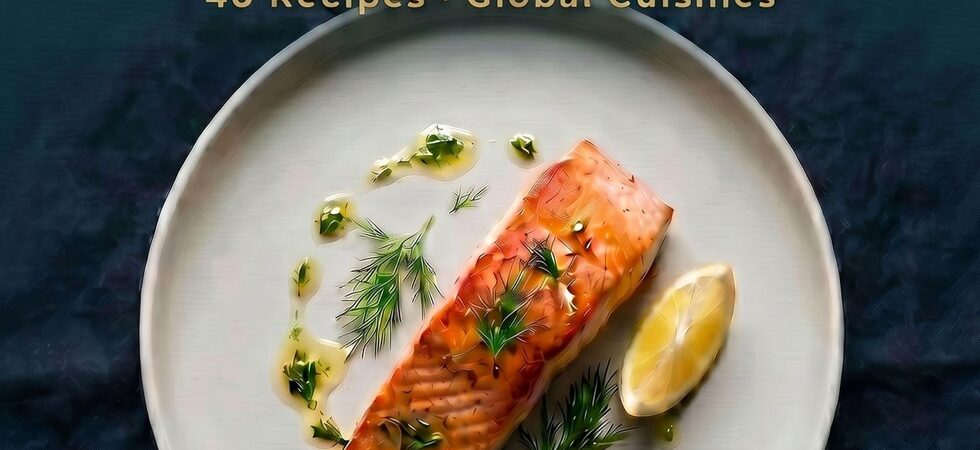
The most useful thing we learned while writing A Pescatarian’s Cookbook was also the most inconvenient: most kitchens are not built for fish. They are built for chicken, for ground beef, for the long braise. Then a fillet arrives — a side of salmon, a trout, a few mackerel from the Saturday market — and the pantry comes up short. What should be the easiest dinner of the week turns into a hunt for the small things that make fish taste like itself.
The fix is not a long list. Five things, kept within reach. Get them right, and the next forty dinners from the sea more or less cook themselves.
1. Flaky finishing salt
Not table salt, and not the iodized box. Flaky finishing salt — Maldon, fleur de sel, any sea flake that crushes between your fingers — is a different tool for a different moment. Cooking salt seasons the flesh as it cooks; a pinch of flake, scattered over the fillet just before it reaches the table, gives it a clean crunch and one last lift of the sea. It is what the final thirty seconds of dinner can do.
2. A bright acid you can pour
Lemon is the obvious answer, and lemons run out. The quieter answer is a bottled brightness you always have on hand: a white balsamic, a jar of preserved Meyer lemon, a splash of Banyuls vinegar or verjus. Fish wants acid even more than it wants salt, and a bottle within reach means you never lose a Wednesday to an empty fruit bowl.
3. An olive oil worth drinking
Keep two. The first is the everyday oil, a clean Spanish or Italian blend for the pan. The second is the one you would happily drink from the spoon — a single-estate, peppery green oil you never cook with, only finish with. A teaspoon poured over a piece of cod, a bowl of mussels or a fillet of grilled mackerel does more than most sauces ever will. Much of what we call a good fish dish is really a good oil dish.
4. A living herb
Dried parsley will not save a dinner; a growing one might. The herbs that change a dish are the ones still on the plant, cut a minute before they meet the plate. Keep a pot of flat-leaf parsley or basil on the windowsill and tear a handful over the fish at the end. It costs almost nothing, it lasts for weeks, and it makes a kitchen smell like dinner rather than like a microwave.
5. Alliums you actually replace
Garlic and shallots are the least glamorous things on this list and the ones a fish kitchen leans on hardest. The trouble is that they slip by unnoticed — the garlic turns hollow, the shallot softens, and a vague “onion” gets drafted in to stand where they should be. Buy a fresh head of garlic and a few shallots every week, the way you buy the fish itself. Firm, sweet and recent, they carry a weeknight dinner further than any spice rack.
One thing that is not a pantry item but belongs in the same breath: a knife you have actually sharpened. Most kitchens fail us on the third weekday in a row not for want of ingredients, but because the blade has gone dull. Sharpen it on Sunday. It is the least romantic habit in cooking, and the one we could never skip.
These are the five — six, if you count the knife — that our test kitchen kept circling back to while writing A Pescatarian’s Cookbook. The book takes it for granted that you have them in hand, so its pages can spend their time on the fish itself instead of on yet another sauce from a jar.
If you would like the rest — forty recipes drawn from Valencia, Provence, West Africa and the American South, along with the sourcing notes and the wine pairings — A Pescatarian’s Cookbook is on the shelf now.